5 Costly Mistakes Airbnb Owners Make in Marrakech
Classic mistakes cost Marrakech Airbnb hosts 30-40% of potential revenue annually. Quantified analysis and solutions.
Looking at the Airbnb market in Marrakech, a pattern keeps repeating. The owners who underperform do not necessarily lack good intentions or a beautiful property. They systematically make the same mistakes — mistakes that, taken together, cost them between 30 and 40% of their potential annual revenue.
Here are those five mistakes, quantified and documented.
Mistake 1: Applying a Fixed Rate All Year Round
This is the most costly and most widespread mistake. A majority of owners in Marrakech apply a pricing structure that changes little or not at all according to the season, local events, or real-time demand.
What it costs you in concrete terms: during high season (October–December, February–March), a 2-bedroom riad in the Medina can command between 1,800 and 2,800 MAD per night. An owner with a fixed rate of 1,400 MAD is indeed fully booked, but is leaving between 400 and 1,400 MAD on the table every night. Over 60 nights of high season, that is 24,000 to 84,000 MAD in lost revenue.
In low season, the reverse mistake occurs: the fixed rate is too high, guests choose more reactive competitors, and the property sits empty. July and August represent a 40 to 50% drop in demand in Marrakech — dynamic pricing would allow you to retain 60 to 70% of your usual bookings by adjusting intelligently downward.
The practitioner's rule: your rate should vary by a ratio of 1 to 2.5 between low and high season. A property priced at 900 MAD in July should be able to display 2,200 MAD in November without market resistance. Owners who apply this rule generate on average 20 to 35% more revenue than those who remain on a fixed rate.
Mistake 2: Photos That Do Not Sell the Property
Airbnb data is unambiguous: listings with professional photographs have a click-through rate (CTR) 25 to 40% higher than those with smartphone photos. And on Airbnb, a higher CTR leads to better algorithmic ranking, which amplifies the gap further.
What it costs you in concrete terms: if your occupancy rate is 62% with poor photos and professional photography brings you to 72%, at an average rate of 1,200 MAD over 365 days, that is an additional 43,800 MAD in annual revenue. A professional photography session in Marrakech costs between 2,000 and 5,000 MAD. It pays for itself in fewer than two additional nights.
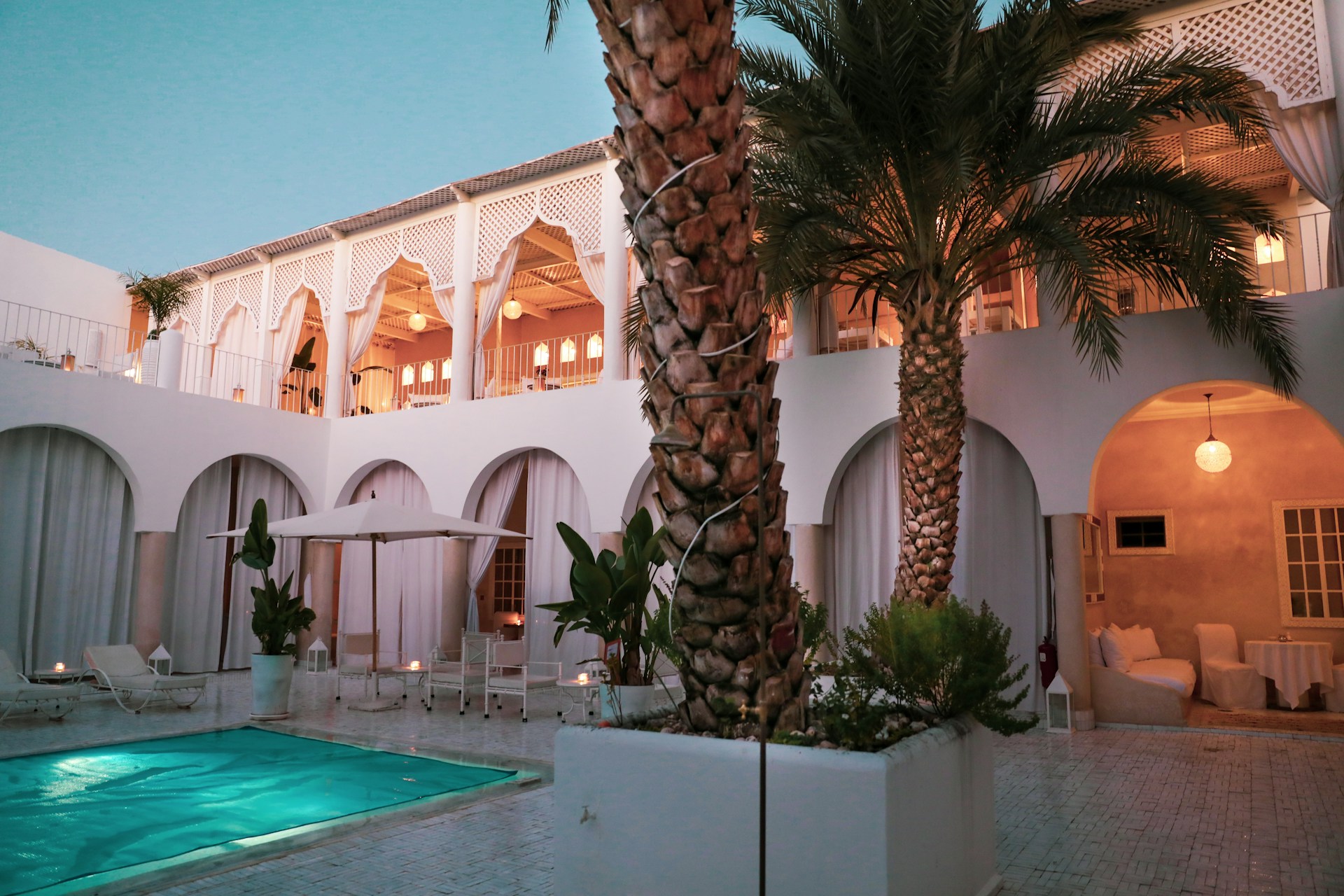
The most frequent errors we observe: photos taken with direct flash that flattens volume and depth, no photos of the patio or terrace (which are often the real selling points of a riad), blurry or overexposed images, and — above all — no staging. A riad photographed empty, without decoration, without cushions arranged, without candles lit in the evening, loses 50% of its visual appeal.
Our recommendation: commission a photographer who specialises in accommodation. Plan a session in natural light (morning or late afternoon) and an evening ambiance session (warm lighting, candles). Make sure you have at least 30 quality photographs. The cover photo must be the most iconic view of your property — often the patio or the rooftop terrace.
Mistake 3: A Response Time of More Than One Hour
Airbnb measures your average response time and uses it as a ranking criterion. A host who responds in under an hour is favoured algorithmically over a host who responds in 6 hours, even if all other variables are identical.
What it costs you in concrete terms: a high response time has three cumulative negative effects. First, you lose the "Fast Responder" badge, which builds traveller confidence. Second, you lose eligibility for Superhost status, which itself increases your visibility by 12 to 18% according to Airbnb market studies. Third, guests who do not receive a prompt response book with a competitor — on Airbnb, booking decisions are often made within the half hour following the first point of contact.
Statistically, owners with an average response time of more than 2 hours record 12% fewer bookings than those who respond in under 30 minutes, for comparable listings and prices.
The solution: activate Airbnb's automated replies to acknowledge enquiries immediately. Handle specific requests within the day. If you cannot guarantee this level of responsiveness consistently, that is precisely the role of a dedicated property manager, reachable seven days a week.
Mistake 4: A Rigid Minimum Stay in Low Season
A 3-night minimum during high season is perfectly justified — it reduces turnover, lowers cleaning costs, and secures revenue. But imposing the same minimum in July and August structurally deprives you of the majority of available demand.
What it costs you in concrete terms: in low season in Marrakech, guest flows are dominated by short weekend stays (2 nights), business trips (1 to 2 nights), and stopovers (1 night). A 3-night minimum eliminates 60 to 70% of these requests. Over a July month with 15 potentially bookable days at a 2-night minimum, you might convert 7 reservations. With a 3-night minimum, you convert 3.
The gap-filling problem is real: if you have a booking from the 3rd to the 6th and another from the 10th to the 15th, the 4-day gap (7th–10th) will never fill with a 3-night minimum. With a 1 or 2-night minimum, that gap can generate 2 to 3 additional bookings.
Our recommendation: adapt your minimum stay to the period. July–September: 1-night minimum, except on event weekends. June and October: 2-night minimum. November–March: 3-night minimum. This dynamic flexibility can represent 15 to 20% additional revenue over the 4 months of low season.
Mistake 5: Ignoring Negative Reviews or Responding Defensively
Airbnb reviews are your most valuable reputational asset. An internal Airbnb study shows that a property moving from 4.7 to 4.9 stars sees its booking rate increase by 10 to 15%. Conversely, a negative review left unanswered or met with a defensive response can be very costly.
What it costs you in concrete terms: a single 1-star review on a listing with 30 positive reviews can drag the overall score from 4.9 to 4.7. This difference of 0.2 points can push you below Airbnb's algorithmic promotion thresholds. The resulting loss of visibility can represent 8 to 12% fewer bookings over the following 3 months.
The most common mistake: not responding at all, or responding defensively ("the guest was wrong", "they were acting in bad faith"). This approach aggravates the problem — future guests read the host's response just as much as the review itself.
The effective response strategy: respond to all your reviews, positive and negative. For negative reviews, follow this structure: acknowledge without justifying yourself ("Thank you for this feedback, I am genuinely sorry your stay did not meet your expectations"), correct the facts if necessary in a calm and factual manner, explain what you have improved since, and close positively. This response is not for the guest who left the review — it is for the thousands of future guests who will read it.
For unfair or fraudulent reviews, Airbnb has a dispute procedure. Document each stay photographically so you can substantiate any challenge.
These five mistakes are not isolated anecdotes — they are patterns that recur systematically across the Airbnb market in Marrakech. Collectively, they explain the majority of the gap between a property's potential and what it actually generates.
If you want to know which of these mistakes you are currently making and what they are costing you precisely, our free audit analyses your listing point by point and delivers a quantified report within 48 hours. No commitment, no fees. It is simply the most direct way to find out where you stand.
Ready to grow your revenue?
Get a free audit of your Airbnb property and discover your real potential.
Get my free auditSwitching concierge providers? See our approach